AI involvement in corporate leadership is advancing faster than anticipated. A significant development is Delaware’s proposed sandbox for AI companies or AIC, which would be led solely by AI agents without human directors and officers. AICs raise questions regarding accountability, governance, and regulatory design. Until more practical experience with such entities becomes available, it is reasonable to assume that AICs present greater risks than companies led by humans. A prudent approach is therefore to proceed cautiously, including with heightened regulatory safeguards, until the hypothesis of greater risks can be disproven. The question, then, is what those regulatory safeguards should consist of and how to design them.
Thoughts on Regulatory Options
Minimum capitalization and reliance on traditional corporate law veil piercing, as outlined in Delaware’s AIC sandbox proposal, are one possibility. However, capitalization is difficult to calibrate and traditional veil piercing lacks teeth. It is difficult to set the appropriate amount of mandatory capital, while veil piercing is rare, and even when it succeeds, claims against an incorporated shareholder of an AIC would still run up against limited liability.
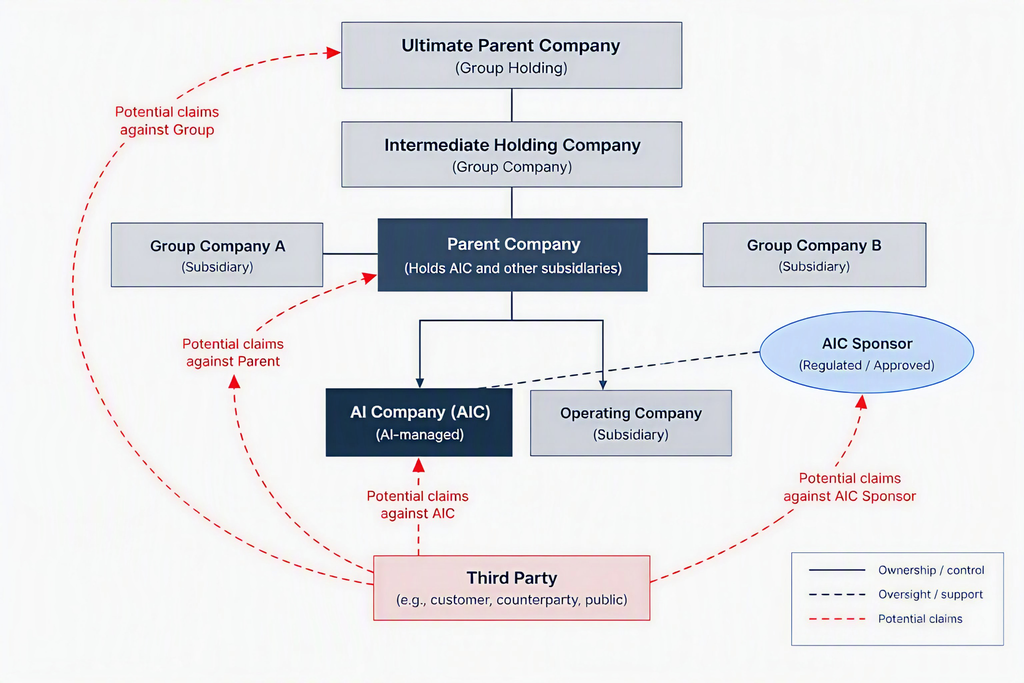
To account for the possibility of heightened risks of AICs, we arguably need to look further. Potential measures worth considering include broader recourse against shareholders and parent/group companies, mandatory insurance, and designated AIC sponsors. These measures would ideally be combined with broader ex ante and ex post rules on AI safety.
AIC and Parent/Group Company Liability
Proposals for enlarged shareholder and parent/group company liability have been discussed for years. Given the entrenched principle of limited liability, none of them have come close to being implemented. Yet, commentators across the ideological spectrum agree that limited liability vis-à-vis involuntary creditors may be justifiably curtailed for corporate shareholders.
In essence, the argument is that allowing creditors to claim against the assets of parent companies is acceptable as it does not create unlimited liability for ultimate investors; that the traditional benefits of limited liability, such as reduced monitoring costs and capital aggregation, are less compelling in the corporate group context; and that moral hazard and risk-shifting concerns can be amplified within corporate groups. Thus, AIC regulation could credibly incorporate recourse against parent companies of agentic-led entities, or even introduce group-wide liability to avoid undue asset-shielding structures.
Mandatory AIC Sponsorship
Another option – instead of or in combination with group liability – is a mandated sponsorship model, akin to approaches found in the securities listing process. For instance, the UK requires that AIM-listed companies (a sub-market of the London Stock Exchange) appoint and retain an approved nominated advisor (Nomad). The Nomad’s obligations pertain to assessing listing candidates and advising them on their obligations on an ongoing basis. Similar provisions are in place in Hong Kong. Meanwhile, in Canada, sponsorship requirements are waived for most TSX listings and have been recently removed for the TSXV. The latter development highlights potential issues with cost and administrative burdens related to sponsorship.
Nevertheless, due diligence in capital markets is usually already provided through routine legal, audit, and underwriting activities, whereas these layers of outside scrutiny and assurance are not necessarily present in the context of AIC launches. A sponsorship model may therefore still be justified and less duplicative. Additionally, it may prove more politically feasible than reforms to limited liability.
Qualified third parties could be required to ensure appropriate due diligence of a proposed AIC, focusing on aspects such as safety of the underlying AI systems, intended activities, oversight and risk management, and intervention mechanisms. These factors might also inform any required minimum capital and insurance for the AIC. Sponsorship could also entail third party certifications, that is compliance with benchmark standards in areas such as AI governance, safety, and operations. Sponsors would earn fees, possibly on an ongoing basis if they offer monitoring or recurring audits, but also assume liability for lack of care in the provision of services.
The scope and extent of sponsors’ liability requires careful calibration, including in terms of the parties that duties are owed to. For example, duties could be owed to the AIC itself, a regulatory body, known third parties, the public, or a combination thereof. Liability could also be capped and/or backed up by mandatory insurance.
Insurance Solutions
Adding to the gatekeeper approach, mandatory insurance could also be a useful requirement, either at the level of the AIC or its members. Acting as another form of gatekeeper (in addition to sponsors) and with the potential to mitigate excessive risk-taking by insured parties, insurers could through their provisions of coverage and conditions protect AIC and third parties alike, taking on the role of soft law providers and almost de facto regulators.
To be sure, insurance has important limitations and comes with uncertainties. Insurance is not a solution by itself, but it has the potential to add value in tandem with other measures. As in the case of other technological innovations, we should expect insurance to gradually evolve and become more sophisticated once more data on AICs will be available in the future.
Need for Coordinated Approaches
Finally, corporate law – especially if only enacted in selected jurisdictions – cannot in isolation establish and govern AIC. Corporate law may provide that the member in an AIC is not responsible beyond a minimum capital contribution and limited veil piercing, but unless these protections are aligned with non-corporate laws that set standards for AI and may form the basis of claims, they are of limited use. Hence, there is a need to coordinate corporate law with contract, tort, product liability, criminal, and regulatory laws – ideally across jurisdictions. While emerging case law on AI and algorithmic harms provides some initial guidance, unsettled questions remain that would benefit from regulatory certainty and coordination.
For instance, regulations could specify the duties of those that develop, deploy, and use AI; address accountability gaps based on a lack of foreseeability of algorithmic harms and evidentiary hurdles; and develop rules for allocating responsibility between multiple actors that contributed to an AI system. At the federal level, the US has thus far refrained from adopting a comprehensive AI regulatory framework. In terms of proposed legislation, the AI LEAD Act is far from encompassing, but it would establish a product liability framework with tailored provisions for holding AI developers and deployers accountable, including in cases involving cross-jurisdictional corporate structures and risk-shifting via contractual waivers. However, all states have enacted AI-related legislation, with several indirectly addressing corporate accountability through various rules concerning AI standards and obligations.
Additional commentary on AI companies can be found in this Insight and op-ed.